
What I Learned from 4 Teenagers on North of Normal
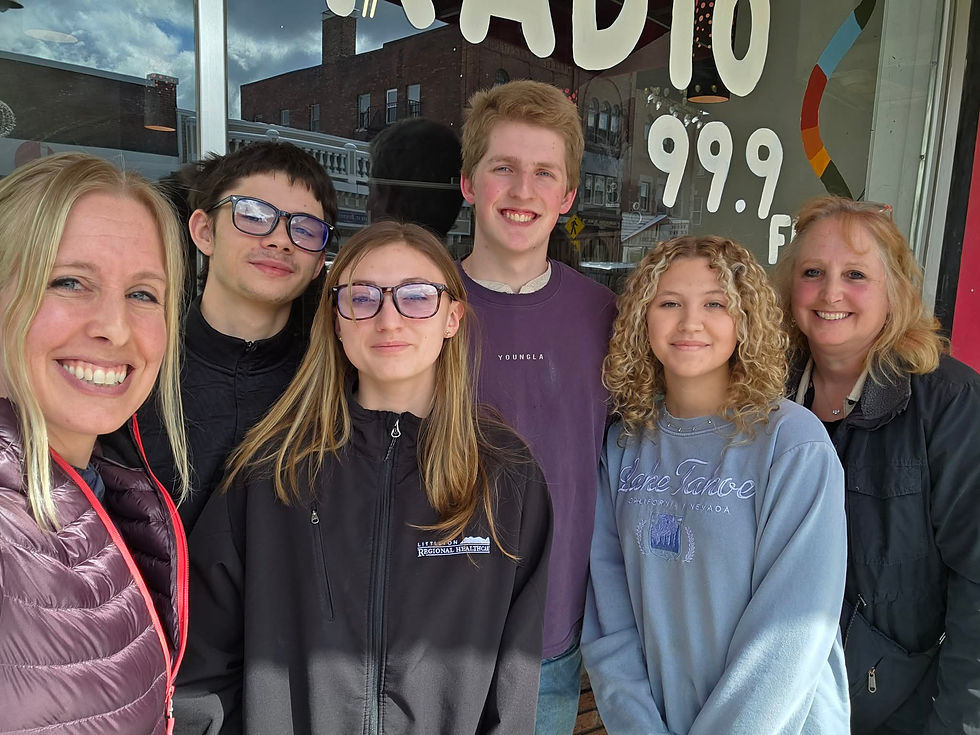
This week’s episode of North of Normal was so different and so north of normal that it felt important to write down. The day didn’t start out like usual...
I had been in my head more than normal that morning, dealing with some quiet doubt that didn’t really have any evidence behind it, but was loud enough to notice. It wasn’t stopping me, but it was there.
I left my apartment and started walking down Main Street toward the station, still carrying a little bit of that with me. I had a show that morning with four students from the Lisbon High School broadcasting class, and that alone was enough to make me a little uneasy. Up until that point, the most guests I'd ever had on at once was two. Four felt like a different level of coordination, a different level of responsibility, and I wanted to make sure I had everything set up the right way. I had also never had teenagers on my show, which presented its own possibilities.
I tried calling Nate, the station director, just to double check a few things before I got there. But instead of reaching him, I kept getting the Verizon Payment Processing Center. I hung up and tried again. Same thing. Tried again. Same thing.
I kept walking.
When I got to the station, I unlocked the door, stepped inside, and went straight into setup mode. I took my coat off, looked over the board to make sure everything was where it should be, and started arranging the room. There are only three guest microphones, so I set up four chairs across the table, placing two of them to share one mic, hoping the students would figure out who was willing to share.
Then I heard crackling feedback coming through the system.
Not subtle feedback. The kind that makes you stop immediately and try to fix it.
I tried calling Nate again. Same issue.
So I switched to Messenger, and thankfully that worked. He answered, and within a couple of minutes he walked me through what buttons to push, and the feedback stopped almost immediately.
Right as we were finishing, I looked up and saw four students and their teacher walking up to the door.
I said a quick 'thank you' to Nate, hung up, and went to meet them.
When I walked to the front of the room, they were all standing in a line, completely silent, just looking at me.
And I remember thinking, okay… this is going to be interesting.
I welcomed them in, thanked them for coming, gave them a quick tour, and brought them back to the recording room. We went over a few tips, talked about what it’s like to be on the air, and if I’m being honest, I wasn’t entirely sure how we were going to fill an hour. They seemed too quiet. A little unsure. Not especially talkative.
I remember thinking, well, we can always go to music if we need to.
And then, before I really had time to think much more about it, it was 10:00.
And we were live.
What happened next is what I’ve been thinking about ever since.
Because the same group that stood silently at the door started talking. Not all at once, not perfectly, but honestly.
Emily began by talking about her role in the class and how much she enjoys editing. She described it as the part where everything comes together, where the story actually takes shape. And then she shared something simple but meaningful—she talked about hearing about the polaroid wall at Tailswag on the show, and then going to see it for herself. It wasn’t a big, dramatic example, but it made something clear. When something feels real, it doesn’t just stay in the conversation. It carries into real life.
Cassidy followed by talking about growing up in Lisbon and being part of a community where people know each other. There was a steadiness in the way she spoke about that, and when she described what she wants to bring to what they’re creating, she said she wants to be real. Not overly produced, not forced, just real. She also shared how much the class has helped her become more expressive and more comfortable speaking, and it was clear that this was something she had grown into over time.
As the conversation continued, Hunter shared parts of his story that carried more weight. He talked about moving around, about different places he’s lived, and he said that when he lived in Bethlehem, he felt like he wasn’t liked there. He didn’t pause on it or try to reshape it into something else. He just said it, and then continued talking about where he is now, about basketball, about what he’s working toward. Later, when I asked him what North of Normal meant to him, he talked about "being based,” explaining that it meant being unique. Not weird, not outside, just yourself.
Miles added another layer to the conversation when he talked about how he ended up in the class because he needed one more credit to fill his schedule. There was no attempt to make that sound like anything more than it was. But then he talked about what he’s working on now—being more expressive on camera and wanting people watching to feel involved.
As the conversation moved between them, what stood out wasn’t just what each of them said individually, but how it all connected. Each of them was speaking from exactly where they are, talking about what they’re learning, what they’ve experienced, and what they’re working toward. And woven through all of it, sometimes directly and sometimes more subtly, was their teacher, Mrs. Woods.
They spoke about the class in a way that made it clear this wasn’t just something they were doing on their own. It was something they were being guided through. They had been given the opportunity to go out into the community, to interview people, to try things they hadn’t done before, and to grow into it over time. She didn’t take up space in a way that redirected the conversation, but her presence was there in everything they said—in their growth, in their willingness to speak, and in the fact that they were in that room at all.
What stood out most as the hour went on was how different the room felt from when they first walked in.
The same group that stood silently in a line at the door was now fully engaged in conversation. Not perfectly, not without pauses, but honestly. Willing to share. Willing to speak. Willing to be part of something they were still learning how to do.
And none of it felt forced.
By the time the hour came to a close, the question I had at the beginning—how are we going to fill this time—felt almost irrelevant. Because we didn’t have to force anything. We just had to let it happen.
And sitting with that afterward, I realized how much of what I had been carrying into that morning had nothing to do with what actually unfolded. I had walked in thinking about whether I was doing it right, whether I had set things up correctly, whether I was going to be able to carry the conversation for an entire hour. And none of that ended up being what mattered.
What mattered was that they showed up.
They spoke from where they are. They said what felt true to them. They didn’t try to be anything other than themselves.
And in that, something happened.
The conversation built itself. The space filled naturally. The moments that mattered came through without being forced or planned.
And I think that’s something I needed to be reminded of.
That we don’t have to have everything figured out before we show up. We don’t have to quiet every doubt or feel completely confident. We don’t have to carry the whole experience on our own.
Sometimes, all we have to do is show up as we are and let other people meet us there.
Because there is something about that exchange—about being present with other people, about listening, about allowing things to unfold—that creates something we couldn’t have created on our own.
And more often than not, that’s the thing that quiets the doubt. Because we stopped giving it our attention and stepped into something real instead.
I’ve been thinking about that since yesterday, and it feels like a simple reminder, but an important one.
Just show up.
Let it be real.
Let other people in.
That’s where the good stuff happens.
And as a small side note—because it still makes me laugh—I did figure out later why my calls weren’t going through that morning. My autopay had been disrupted, and all I had to do was add funds. As soon as I did, everything worked again.
Simple as that.
-Amanda


This is awesome Amanda! Emily is my granddaughter and she is a wonderful loving person that I love so much!